"It should surprise, but not with just anything. And certainly not with things which are astonishing, surprising or strange already because they have never been seen, are unusual or out of the ordinary.... The surreal is not a monster, a calf with five hooves or two heads, the freak result of nature bungling one of its creations, but it is a normal calf.... The surreal exists within us, in the things which have become so banal that we no longer notice them, and in the normality of the normal."
*
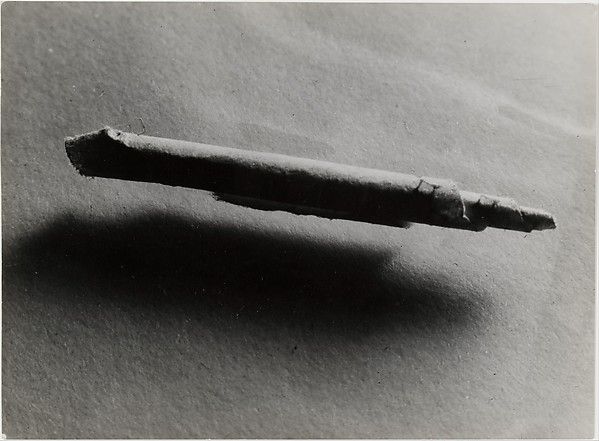
The book I have gives an overview of Brassai's periods and thematic concerns. I especially love his "Involuntary Sculptures" (1932), which I didn't remember looking at before:

*
These loaves of bread, they seem suddenly like bloated worms embracing. And then the bus ticket sprouts wings and its shadows drift over the sleepy passengers. I'll get off at Les Halles and walk fast to avoid the shadow of the Tour Saint-Jacques.
*
*
As much as Brassaï avoided the doctrinaire surrealism of Breton, these are great examples of convulsive beauty, of all the minute "jolts and shocks" which may not have "much importance" in and of themselves, but are part of this larger scheme, the "one Shock, which does" (Nadja). All these little ticks, pings, pricks, spasms, shocks, convulsions are indeed involuntary, which can be dangerously misunderstood as arbitrary. But like breathing, they are both involuntary and vital.
*
The Involuntary Sculptures reminded me of my favorite Duchamp piece, "Dust Breeding," which Man Ray photographed. If memory serves me, Duchamp discovered these sublime patterns on the "La Mariée" glass after it had been in storage for a substantial period of time:

*
The surrealism of the everyday seems to me an assault on perspective: an act of looking and thinking that erodes habitual points-of-view, that facilitates their collapse, and spawns a reemergence of new points of view, in language, film, or wherever viewpoints position themselves.
But it is also a surrealism of nature, of materiality, of time. Of dust: the great involuntary signal of mortality.
*
Words
You catch water with a pin,
the water turns to slush.
You point at the tree with your hand,
the tree burns.
You divide lines with a shadow.
You open the door for love and death.
-Tomaz Salamun (from Selected Poems, trans. Salamun & Anselm Hollo)

No comments:
Post a Comment