A poem of mine is up at InDigest's podcast series:
Voice of the Interior
Wednesday, December 21, 2011
Tuesday, December 13, 2011
The surreal is a normal calf
Spent some time today with a book of Brassaï's work (Brassaï The Monograph). He has this wonderful bit to say about the surreal:
"It should surprise, but not with just anything. And certainly not with things which are astonishing, surprising or strange already because they have never been seen, are unusual or out of the ordinary.... The surreal is not a monster, a calf with five hooves or two heads, the freak result of nature bungling one of its creations, but it is a normal calf.... The surreal exists within us, in the things which have become so banal that we no longer notice them, and in the normality of the normal."
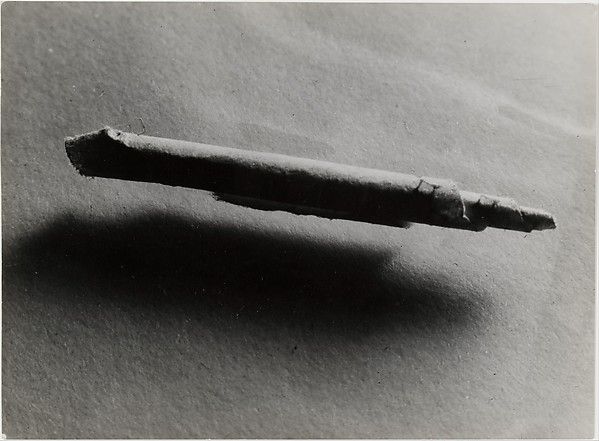
The book I have gives an overview of Brassai's periods and thematic concerns. I especially love his "Involuntary Sculptures" (1932), which I didn't remember looking at before:
The Involuntary Sculptures reminded me of my favorite Duchamp piece, "Dust Breeding," which Man Ray photographed. If memory serves me, Duchamp discovered these sublime patterns on the "La Mariée" glass after it had been in storage for a substantial period of time:
The surrealism of the everyday seems to me an assault on perspective: an act of looking and thinking that erodes habitual points-of-view, that facilitates their collapse, and spawns a reemergence of new points of view, in language, film, or wherever viewpoints position themselves.
But it is also a surrealism of nature, of materiality, of time. Of dust: the great involuntary signal of mortality.
"It should surprise, but not with just anything. And certainly not with things which are astonishing, surprising or strange already because they have never been seen, are unusual or out of the ordinary.... The surreal is not a monster, a calf with five hooves or two heads, the freak result of nature bungling one of its creations, but it is a normal calf.... The surreal exists within us, in the things which have become so banal that we no longer notice them, and in the normality of the normal."
*
The book I have gives an overview of Brassai's periods and thematic concerns. I especially love his "Involuntary Sculptures" (1932), which I didn't remember looking at before:
*
These loaves of bread, they seem suddenly like bloated worms embracing. And then the bus ticket sprouts wings and its shadows drift over the sleepy passengers. I'll get off at Les Halles and walk fast to avoid the shadow of the Tour Saint-Jacques.
*
*
As much as Brassaï avoided the doctrinaire surrealism of Breton, these are great examples of convulsive beauty, of all the minute "jolts and shocks" which may not have "much importance" in and of themselves, but are part of this larger scheme, the "one Shock, which does" (Nadja). All these little ticks, pings, pricks, spasms, shocks, convulsions are indeed involuntary, which can be dangerously misunderstood as arbitrary. But like breathing, they are both involuntary and vital.
*
The Involuntary Sculptures reminded me of my favorite Duchamp piece, "Dust Breeding," which Man Ray photographed. If memory serves me, Duchamp discovered these sublime patterns on the "La Mariée" glass after it had been in storage for a substantial period of time:
*
The surrealism of the everyday seems to me an assault on perspective: an act of looking and thinking that erodes habitual points-of-view, that facilitates their collapse, and spawns a reemergence of new points of view, in language, film, or wherever viewpoints position themselves.
But it is also a surrealism of nature, of materiality, of time. Of dust: the great involuntary signal of mortality.
*
Words
You catch water with a pin,
the water turns to slush.
You point at the tree with your hand,
the tree burns.
You divide lines with a shadow.
You open the door for love and death.
-Tomaz Salamun (from Selected Poems, trans. Salamun & Anselm Hollo)
Friday, December 2, 2011
Double Nate
TOMORROW NIGHT @ MYOPIC BOOKS 7 PM
I'm reading with Nate Slawson, author of the wonderful Panic Attack, USA
Tuesday, November 15, 2011
Bernadette Mayer's journal ideas & experiments.
Thanks to Hai-Dang Phan for pointing this out on Facebook!
Monday, November 14, 2011
I'm Reading this Wednesday at Danny's
Novemeber 16, 7:30 PM with Lina ramona Vitkauskas and Garin Cycholl
View Larger Map
Please come to the Interior!
View Larger Map
Please come to the Interior!
Thursday, November 10, 2011
Sunday, October 16, 2011
Tuesday, October 11, 2011
Live From Prairie Lights
I'll be reading at Prairie Lights this Thursday, 10/13, at 7 PM, with Wayne Miller. Looking forward to this homecoming of sorts!
Saturday, October 8, 2011
Monday, September 19, 2011
Wednesday, July 27, 2011
More on the malady of the visual...
Wednesday, July 6, 2011
astral homunculi in cooking pots
Follow up to my post on Artaud's idea of poetry as a magnetic innervation of the heart: Artaud also has this choice bit from the March 7, 1946 letter to Georges Le Breton:
"For Gérard de Nerval would not have suffered from life if life had not been put in symbols, had not been typified in symbols, cut up into astral homunculi in cooking pots, and if these symbols and allegories of beings, made desperate and repressed by the rituals of alchemy, had not moreover been put outside semen, outside that seed of tumors and semen which in real life leads to syphilis or plague, to suicide or madness. -- What is madness? A transplantation out of essence but into the abyss of the exterior interior. What is essence? A hole or a body? Essence is this hole of a body that the abyss of the circular mouth of the cooking pot has never truly made signify facing the impatiences of alchemy." (Trans. Clayton Eshleman, in Watchfiends and Rackscreams)
This description of essence just floors me. I understand this "hole of a body" as a simultaneous interior/exterior: a kind of undifferentiated plane (in the Deleuzean sense, obviously), but maybe something like a catenoid becoming a helicoid--a surface wrapping around itself to create a temporary interior; then dissolving it at will:
I'm also curious about these astral homunculi. What a weird, terrifying, and kind of funny image. My son some times puts little toy dolls in his toy cooking pots. Symbols of being?
"For Gérard de Nerval would not have suffered from life if life had not been put in symbols, had not been typified in symbols, cut up into astral homunculi in cooking pots, and if these symbols and allegories of beings, made desperate and repressed by the rituals of alchemy, had not moreover been put outside semen, outside that seed of tumors and semen which in real life leads to syphilis or plague, to suicide or madness. -- What is madness? A transplantation out of essence but into the abyss of the exterior interior. What is essence? A hole or a body? Essence is this hole of a body that the abyss of the circular mouth of the cooking pot has never truly made signify facing the impatiences of alchemy." (Trans. Clayton Eshleman, in Watchfiends and Rackscreams)
This description of essence just floors me. I understand this "hole of a body" as a simultaneous interior/exterior: a kind of undifferentiated plane (in the Deleuzean sense, obviously), but maybe something like a catenoid becoming a helicoid--a surface wrapping around itself to create a temporary interior; then dissolving it at will:
![]() |
| from http://www.math.hmc.edu/~gu/curves_and_surfaces/surfaces/catenoid.html |
I'm also curious about these astral homunculi. What a weird, terrifying, and kind of funny image. My son some times puts little toy dolls in his toy cooking pots. Symbols of being?
Monday, July 4, 2011
a dentist may indeed need a mop
I love epigrams and aphorisms, especially about poetry. I love them in two ways:
Way 1: if they're good, they give you a whole field to ruminate on. They shut you up and make you masticate a bit.
Way 2: they're fun to grapple with--to explore how they might play out in concrete terms, to quarrel with, to figure out whether I agree with them or not (usually back and forth in an interior monologue), etc.
Way 1 and Way 2 may be nearly identical. Not sure.
Anyhow, I was please to recently read Mark Yakich's "Yakking Points" which he wrote for his students & published in the Boston Review. I generally admire Yakich's work and admire poets who have the guts to throw general statements out there to the wolves. Being part wolf myself, I've copied some of Yakich's epigrams (in blue italics) and interspersed them with my inane commentary (I did a similar post on a piece by Jennifer Moxley last summer.)
*
Written language, especially poetry, is inherently a flawed translation of lived life. This sentence included.
I'm inclined to disagree with the premise here. I don't believe language translates life at all--this model of thinking necessarily incurs the "flawed copy" syndrome (i.e. Platonism). Rather, language intersects with life as a kind of force (of will, expression, enthusiasm, sorrow, etc). In its intersections it both influences life and is influenced by life.
*
Whenever you read a poem, read it out loud. Your ear will pick up more than your head will allow. That said, poetry had better be more than a medium for saying things in a pretty way. Poetry is more than ear candy.
I agree and I agree sort of. I mean, there's nothing wrong with ear candy. I'm waiting for the human so evolved that she can find her sustenance on candy alone. The underlying metaphor here is that poetry should be more "substantial," or provide better "sustenance" than candy. Well, I don't mind the emotional or spiritual sustenance that certain kinds of poems can supply, but I'm not ready to write off other more sugary delights.
But I agree in this regard: I can't stand "kiss me I'm poetical" work, poetry too in love with its own rhetoric, its own voice, its trills and riffs.
*
There is no hidden meaning, only “meanings” you’ve not yet realized are right in front of you because you’re not practiced in reading poems. Poetry is a convention like anything else. And you learn the rules of it like anything else—e.g., driving a car, baking a cake, fondling a lover.
Agree and disagree. I can't stand the notion that there's a hidden meaning waiting to be uncovered by readers who know how to cut through the rhetoric and wield their hefty analytical tools--the kind high school exercise that drives kids crazy. But on the other hand, suggesting that there are "rules" only begs to one to break them.
*
Although many consider figurative language the essence of poetry, for the life of a poet metaphor will sooner or later become an illness.
Cool point. Sometimes I think poetry itself is a kind of illness, a viral outbreak, a contagion that cannot be contained because it spreads by contaminating others with a kind of magnetic linguistic-musical-spiritual enthusiasm--like cells multiplying, poets divide and proliferate.
*
Literary theory is just another kind of literature.
Yep. I've been saying that for a long time.
*
Poetry is a form of prayer. Though most poets don’t know to whom or for what they are praying.
This is the kind of cheesy shit that gives poets a bad name.
*
The word “honest” in describing a poem is about as useful as a mop is to a dentist.
I don't know, after a particularly intense root canal, a dentist may indeed need a mop.
*
When reading a poem, try to come to it on its terms, not yours. Don’t try to fit the poem into your life. Try to see what world the poem creates. Then, if you are lucky, its world will help you re-see your own.
Yes. Good point.
*
You will gain a greater understanding of a poem by writing a single parody of it than by reading all the literary criticism of it.
Having tried both approaches, I'd say rather that one gains different understandings. But maybe understanding's not even the right term. Really, do we want to understand poems? No I'm not making an argument for hermeticism or obscuritanism -- but I think tuning ourselves to the right feeling of a poem is as important as "understanding" it. And good criticism, too, enhances one's ability to think and feel with a poem, not simply to understand it as a coded message. Rather, I think a part of me becomes the poem, or is becoming-poem x, and find the right way to plug into this model of feeling/becoming is what I want out of reading poems. In becoming-poem a reader follows the poem's trajectory which usually leads to surprises and transformations. Thus, I agree with Yakich's assertion that:
If your main claim to a poem is that you can relate to it, you aren’t reading it sufficiently. Poems are not meant to be related to; they are meant to offer you something you didn’t know, experience, or imagine before.
Friday, July 1, 2011
Tuesday, June 28, 2011
reading looking smelling thinking
Currently reading or recently have read:
Sunny Wednesday by Noelle Kocot
Helsinki by Peter Richards
Livingdying by Cid Corman
Poem Stripped of Artifice by Mark Lamoureux
My Body and I by René Crevel
And very much feeling
the vibe of Ursula von Rydingsvard's exhibit at the DeCordova, which I've visited twice to see (each time with toddler in tow, so I need to go again I think).
These sculptures are intoxicating -- the smell of the cedar and the organic forms initially remind me a bit of Bataille's idea of the informe*, which he used to describe the way ideas in the abstract escape formal limits (though it has obvious material & formal reference points). I think in a way scent actually touches the idea of the informe more than the forms of the sculptures themselves, which oddly, through repetition, become rather formal. But the scent of the cedar puts these pieces in a more primitive realm, non-visual, formless, airy, so that I feel myself at an intersection of form and formlessness. They evoke "a life of sensations," formless in that the experience of sensation escapes the rigorous limits of categories.
Sunny Wednesday by Noelle Kocot
Helsinki by Peter Richards
Livingdying by Cid Corman
Poem Stripped of Artifice by Mark Lamoureux
My Body and I by René Crevel
And very much feeling
the vibe of Ursula von Rydingsvard's exhibit at the DeCordova, which I've visited twice to see (each time with toddler in tow, so I need to go again I think).
![]() |
| Ursula von Rydingsvard, Bowl with Fingers, 2007–2008 cedar |
*". . . un terme servant à déclasser, exigeant généralement que chaque chose ait sa forme. Ce qu'il désigne n'a ses droits dans aucun (sic) sens et se fait écraser partout comme une araignée ou un ver de terre. Il faudrait en effet, pour que les hommes académiques soient contents, que l'univers prenne forme. La philosophie entière n'a pas d'autre but: il s'agit de donner un redingote à ce qui est, une redingote mathématique. Par contre affirmer que l' univers ne ressemble à rien et n'est qu' informe revient à dire que l'univers est quelque chose comme une araignée ou un crachat." Georges Bataille: "Informe." Documents 7 (December 1929), p. 382. (Radical Art)
Subscribe to:
Posts (Atom)